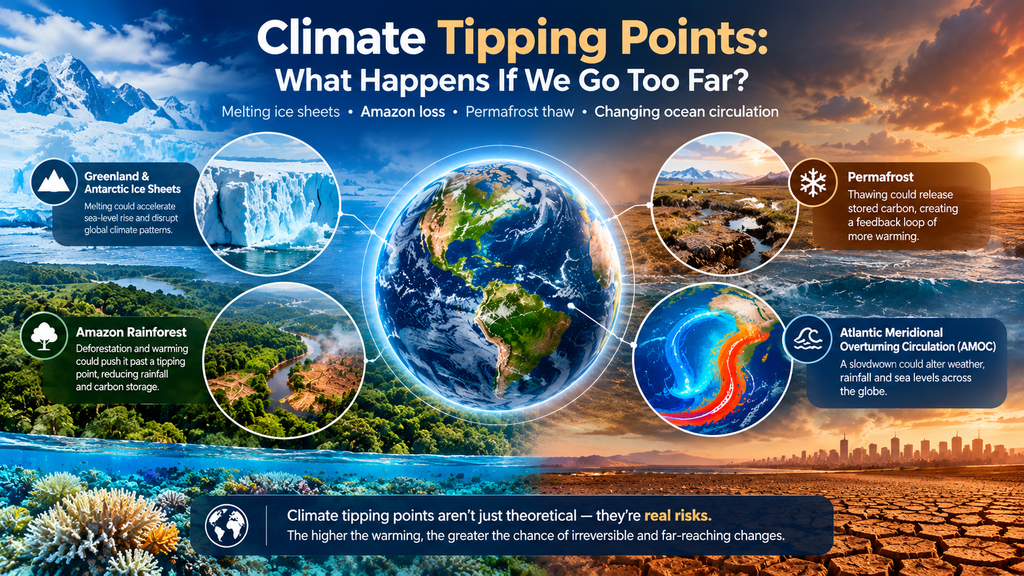
Climate change is often described as a gradual increase in global temperature.
But the Earth’s climate system is not simply a machine that changes at the same speed forever.
Some natural systems can respond gradually to warming until they reach a critical threshold. Beyond that point, a relatively small additional change can trigger a much larger transformation.
These are commonly called climate tipping points.
The concept sounds frightening, but it is important to understand what scientists actually mean by a tipping point.
H2: What Is a Climate Tipping Point?
A climate tipping point is a threshold beyond which a climate system can undergo a major, potentially abrupt and sometimes irreversible change.
The IPCC describes tipping points as critical thresholds beyond which systems can reorganize, sometimes abruptly or irreversibly.
Examples of systems scientists study include:
- Greenland Ice Sheet
- Antarctic Ice Sheet
- Amazon rainforest
- Permafrost
- Atlantic Meridional Overturning Circulation
- Coral reef ecosystems
However, it is important to understand that scientists do not know a single precise temperature at which every tipping point suddenly occurs.
There are uncertainties surrounding timing, thresholds and interactions between different systems.
H2: Why Are Climate Tipping Points So Important?
The biggest concern is that some changes could create feedback loops.
A feedback loop occurs when an initial change causes another change that strengthens the original effect.
H3: The Ice-Albedo Feedback
Ice and snow reflect a large portion of incoming sunlight.
When ice melts, darker land or ocean surfaces are exposed.
These surfaces absorb more solar energy.
More absorbed energy can contribute to additional warming and melting.
The cycle becomes:
Warming → ice loss → darker surface → more heat absorption → additional warming.
This is one reason scientists closely monitor polar ice.
H2: Could Greenland’s Ice Sheet Become Unstable?
Greenland contains enough ice to significantly affect global sea levels if large-scale melting continues over long periods.
The IPCC has high confidence that the Greenland Ice Sheet has threshold behavior in a warmer climate, although there is low agreement regarding the exact nature of the thresholds and tipping points.
This is important because ice-sheet responses can continue over very long timescales.
Even if atmospheric temperatures eventually stabilize, ice sheets may take centuries to respond fully.
H3: Why Sea-Level Rise Matters
Rising seas threaten:
- Coastal cities
- Islands
- Ports
- Wetlands
- Agriculture
- Freshwater supplies
- Coastal infrastructure
The problem isn’t just the average rise in sea level.
Higher baseline sea levels can make storm surges and coastal flooding more damaging.
H2: What About Antarctica?
Antarctica is another major focus of climate research.
The West Antarctic Ice Sheet is particularly important because certain parts rest on bedrock below sea level.
Changes in ocean temperatures can affect floating ice shelves that help slow the movement of land-based ice toward the ocean.
Scientists continue to study how these processes may evolve.
The IPCC notes that the risk of large-scale ice-sheet instability increases as global warming rises.
H2: Could the Amazon Rainforest Reach a Tipping Point?
The Amazon rainforest plays an important role in the global carbon cycle and regional water cycle.
Trees release water vapor into the atmosphere through a process called transpiration.
That moisture contributes to rainfall.
Deforestation and climate change can therefore create additional stress.
H3: The Amazon Feedback Loop
A simplified example looks like this:
Deforestation → less forest → reduced moisture recycling → drier conditions → increased forest stress → additional tree loss.
Scientists are investigating whether continued warming and human disturbance could push portions of the Amazon toward a substantially different ecosystem state.
The IPCC has identified Amazon forest changes among the large-scale risks associated with warming, although considerable uncertainty remains about exact thresholds.
H2: What Happens When Permafrost Thaws?
Permafrost is ground that remains frozen for long periods.
It contains large quantities of organic carbon.
When permafrost thaws, microorganisms can break down previously frozen organic material, potentially releasing carbon dioxide and methane.
This creates another potential feedback:
Warming → permafrost thaw → greenhouse-gas release → additional warming.
The IPCC assesses permafrost carbon as a climate feedback and notes that some associated changes may be irreversible on centennial timescales.
H2: Could Ocean Circulation Change?
One of the most discussed climate systems is the Atlantic Meridional Overturning Circulation, commonly known as AMOC.
AMOC is a large-scale ocean circulation system that transports heat and influences weather and climate patterns around the Atlantic.
The IPCC projects that AMOC will very likely weaken during the 21st century, although there is medium confidence that an abrupt collapse will not occur before 2100.
H3: Why AMOC Matters
A major disruption could influence:
- European climate
- Atlantic sea levels
- Rainfall patterns
- African monsoons
- Asian monsoons
- Marine ecosystems
This doesn’t mean a sudden collapse is expected.
It means that ocean circulation is an important system that scientists are monitoring.
H2: Are We Already Crossing Climate Tipping Points?
This question doesn’t have a simple yes-or-no answer.
Some climate systems are already undergoing major changes.
However, a detected change is not automatically proof that a particular irreversible tipping point has been crossed.
The IPCC emphasizes that risks of abrupt and irreversible changes generally increase with higher warming. It assesses the risk of large-scale singular events such as ice-sheet instability and ecosystem loss as moving toward high risk between approximately 1.5°C and 2.5°C of warming, with uncertainties remaining.
H2: Can We Prevent Climate Tipping Points?
Reducing greenhouse gas emissions is the most important way to reduce the probability and severity of dangerous climate changes.
That means:
- Rapidly reducing fossil-fuel emissions
- Expanding clean electricity
- Protecting forests
- Restoring degraded ecosystems
- Reducing methane emissions
- Improving energy efficiency
- Building climate-resilient infrastructure
The objective isn’t simply to stop temperature from rising tomorrow.
It is to reduce the magnitude of long-term warming.
H2: Final Thoughts
Climate tipping points are not a prediction that Earth will suddenly collapse.
They are a warning about the possibility that some natural systems can respond differently once warming reaches certain levels.
The science contains uncertainties, but the basic message is clear:
Higher warming generally means higher risks.
The earlier humanity reduces emissions, the more opportunities we have to limit dangerous and potentially irreversible changes.