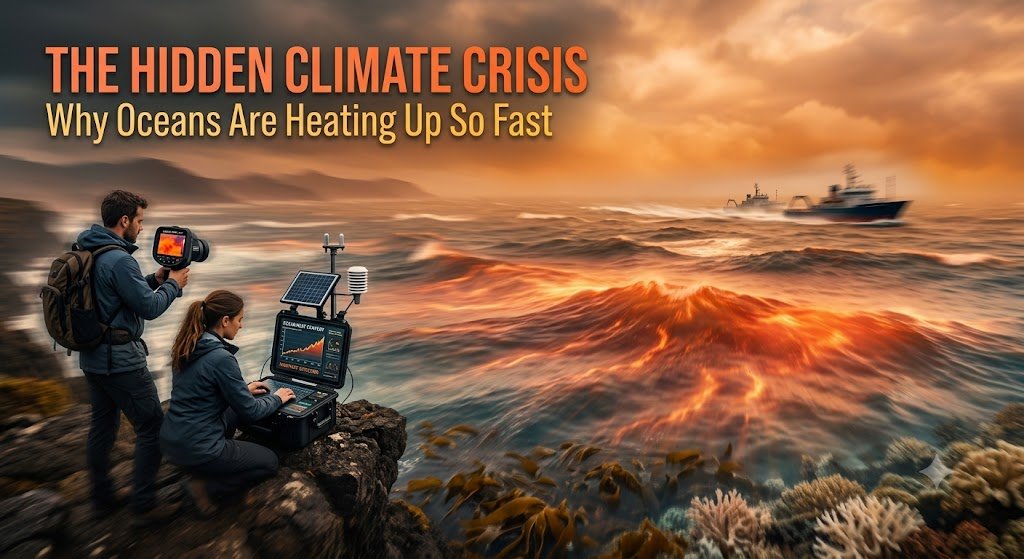
When people talk about climate change, they often focus on rising air temperatures, melting glaciers and extreme weather.
But one of the biggest parts of the climate story is happening beneath the surface of the ocean.
The oceans are heating.
And because oceans cover most of Earth’s surface and absorb enormous quantities of excess heat, ocean warming has consequences far beyond marine life.
It affects weather, sea levels, coral reefs, fisheries and coastal communities.
H2: Why Are the Oceans Getting Warmer?
The simple explanation is that greenhouse gases trap additional heat within Earth’s climate system.
The ocean absorbs much of that excess energy.
According to WMO, the ocean has absorbed enormous amounts of excess heat over recent decades, while NOAA’s latest State of the Climate information reports that global ocean heat content reached another record high in 2025.
H3: The Ocean Is Earth’s Heat Reservoir
Think of the ocean as a giant heat-storage system.
The atmosphere responds relatively quickly to changes in temperature.
The deep ocean responds much more slowly.
This means the ocean can absorb and store heat for long periods.
That makes ocean warming both a consequence of climate change and an important part of understanding future climate conditions.
H2: What Are Marine Heatwaves?
A marine heatwave occurs when ocean temperatures become unusually warm for a sustained period.
These events can last days, weeks or even months.
They can affect huge areas.
The IPCC reports that marine heatwaves have increased in frequency and intensity and warns that continued warming creates increasing risks for ocean ecosystems.
H3: Why Marine Heatwaves Matter
Marine heatwaves can affect:
- Coral reefs
- Fish populations
- Seagrass
- Kelp forests
- Fisheries
- Aquaculture
- Marine food webs
- Coastal economies
When organisms experience temperatures outside their normal range, their ability to feed, reproduce and survive can be affected.
H2: Coral Bleaching: A Visible Warning
Coral reefs are among the ecosystems most visibly affected by ocean warming.
Corals have a close relationship with microscopic algae that live within their tissues.
When ocean temperatures become excessively high, corals can become stressed and expel these algae.
The result is coral bleaching.
Bleached coral appears white because the colorful symbiotic algae have been lost.
If stressful conditions continue for too long, corals can die.
H3: The Fourth Global Coral Bleaching Event
NOAA reported in 2026 that the world’s fourth global coral bleaching event likely ended in mid-2025.
From early 2023 to mid-2025, bleaching-level heat stress affected approximately 84% of the world’s coral reef area, making it the largest global bleaching event recorded to date.
This is significant because coral reefs support enormous numbers of marine species and provide food, coastal protection and economic benefits to communities.
H2: Ocean Warming Is Raising Sea Levels
Ocean warming also contributes to sea-level rise.
There are two major processes to understand.
H3: Thermal Expansion
When seawater becomes warmer, it expands.
That means the same amount of water takes up more space.
This process is called thermal expansion.
H3: Melting Ice
The second major contributor is melting land-based ice.
When glaciers and ice sheets lose mass and that water enters the ocean, global sea levels rise.
The combination creates increasing risks for coastal areas.
H2: How Does Ocean Warming Affect Weather?
The ocean and atmosphere constantly exchange heat and moisture.
Warm ocean water can provide additional energy and moisture to weather systems.
This can influence tropical cyclones, rainfall and atmospheric circulation.
However, the relationship isn’t as simple as saying warmer oceans automatically produce more storms everywhere.
Different regions respond differently.
Climate change can alter the background conditions in which weather systems develop.
H2: What About Ocean Acidification?
Ocean warming isn’t the only problem.
The ocean also absorbs a significant portion of human-generated carbon dioxide.
When carbon dioxide dissolves into seawater, chemical reactions reduce ocean pH.
This process is known as ocean acidification.
It can make it more difficult for some marine organisms to build and maintain calcium carbonate structures.
These include certain corals and shell-forming organisms.
The IPCC warns that ocean warming and acidification together can increase risks to marine biodiversity and fisheries.
H2: Why Ocean Warming Matters to Humans
It may be tempting to think ocean warming is primarily an environmental issue.
It isn’t.
It is also an economic and social issue.
Millions of people depend directly or indirectly on marine ecosystems.
These include:
- Fishing communities
- Coastal tourism
- Aquaculture workers
- Shipping industries
- Coastal agriculture
- Island communities
If marine ecosystems decline, the consequences can move through food systems and local economies.
H3: Fisheries Could Be Affected
Fish respond to temperature changes by moving toward environments where conditions are more suitable.
That can change where fishing communities find target species.
Some fisheries may experience declining catches, while others may see new species appearing.
This creates challenges for food security and livelihoods.
H2: Can the Ocean Recover?
The answer depends on the ecosystem and the scale of the disturbance.
Some ocean conditions can improve when temperatures and emissions stabilize.
But some impacts can persist for decades or longer.
The IPCC notes that changes in deep-ocean warming, sea level and other marine processes can remain effectively irreversible for very long periods.
This is why preventing additional warming is so important.
H2: What Can Be Done About Ocean Warming?
The most effective long-term response is reducing greenhouse gas emissions.
Other solutions can also help:
- Protecting marine protected areas
- Restoring mangroves
- Protecting seagrass
- Restoring coral reefs
- Reducing plastic pollution
- Managing fisheries sustainably
- Improving coastal planning
- Reducing local pollution
These measures cannot replace emissions reduction, but they can improve ecosystem resilience.
H2: Final Thoughts
The ocean is not simply a background feature of our planet.
It is one of the central components of Earth’s climate system.
Record ocean heat, marine heatwaves, coral bleaching and rising sea levels demonstrate why ocean warming deserves far more attention in conversations about climate change.
The ocean may hide much of climate change beneath its surface, but its consequences eventually reach our shores.