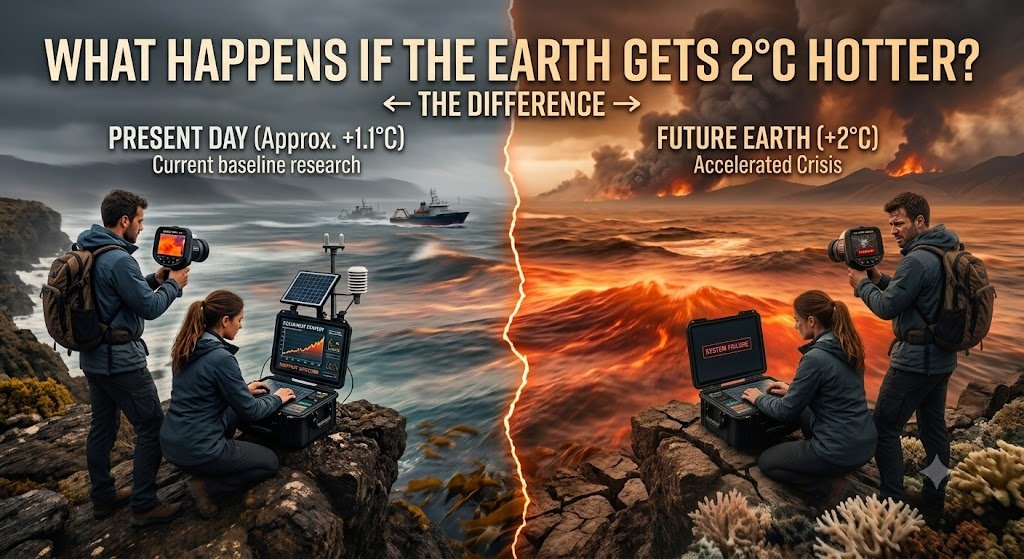
Imagine a world where the average global temperature is approximately 2°C higher than it was before large-scale industrialization.
Two degrees may sound small.
If the temperature of your room increased by 2°C, you might barely notice.
But 2°C of average global warming is enormous when applied across the entire planet.
It changes oceans, ice sheets, ecosystems, agriculture and weather patterns.
And importantly, 2°C does not mean every location becomes exactly 2°C hotter.
Some regions warm much more than the global average, especially over land and at high northern latitudes.
H2: Why Does 1.5°C vs 2°C Matter?
The difference between 1.5°C and 2°C may appear to be only half a degree.
But climate risks don’t necessarily increase in a simple linear way.
The IPCC finds that climate-related risks are higher at 2°C than at 1.5°C, including risks to ecosystems, food, water, health and livelihoods.
The question isn’t whether 1.5°C is “safe” and 2°C is “unsafe.”
Both involve significant climate risks.
Rather, every additional amount of warming increases the scale of many risks.
H2: What Would 2°C Warming Mean for Heatwaves?
H3: More Frequent and Intense Heat Extremes
One of the most direct consequences would be more severe heat extremes.
A warmer average climate shifts the baseline temperature upward.
This makes extreme heat more likely.
For humans, this can mean:
- Greater heat stress
- Higher risk of heat-related illness
- Increased electricity demand
- Greater pressure on cooling systems
- Reduced outdoor working capacity
- Higher risks for vulnerable populations
The IPCC finds that heat-related health risks are lower at 1.5°C than at 2°C.
H2: What Happens to Food Production?
Climate change can affect agriculture through several pathways.
Higher temperatures can directly stress crops.
Changing rainfall can increase drought or flooding risks.
Extreme weather can damage crops during critical growing periods.
Pests and diseases may also change their geographic ranges.
H3: Why 2°C Creates Greater Food Risks
The IPCC reports that limiting warming to 1.5°C rather than 2°C is projected to reduce declines in yields for crops such as maize, rice and wheat.
At higher warming levels, food security risks can become particularly serious in vulnerable regions.
Agriculture is also connected to water.
Less reliable rainfall means farmers may increasingly depend on irrigation.
That can create additional pressure on already limited water supplies.
H2: Will Water Scarcity Increase?
Water is one of the most important climate-change risks.
Climate change can alter:
- Rainfall
- Snowfall
- River flows
- Groundwater recharge
- Soil moisture
- Drought frequency
The effects vary significantly between regions.
Some areas may receive more rainfall while experiencing more flooding.
Others may face longer dry periods.
H3: The Water–Food Connection
Water shortages don’t only affect drinking water.
They also affect:
- Agriculture
- Electricity generation
- Manufacturing
- Sanitation
- Livestock
- Ecosystems
This means climate-related water stress can create cascading effects across economies and societies.
H2: What Happens to Oceans and Sea Levels?
At 2°C, ocean warming and sea-level rise would be greater than at 1.5°C.
The IPCC estimates that by 2100, global mean sea level rise under 1.5°C warming would be approximately 0.1 metre lower than under 2°C warming, although uncertainty exists around future ice-sheet behavior.
That 10-centimetre difference might not sound dramatic.
But across coastlines and densely populated areas, even relatively small increases in average sea level can substantially increase flood risks.
H2: What Happens to Coral Reefs?
Coral reefs are particularly vulnerable to warming oceans.
Higher temperatures increase the likelihood of coral bleaching.
The IPCC finds that limiting warming to 1.5°C rather than 2°C would reduce risks to marine biodiversity, fisheries and ecosystems.
Coral reef decline matters beyond the coral itself.
Healthy reefs provide habitat for marine species and support coastal communities through fisheries and tourism.
They can also help reduce wave energy reaching coastlines.
H2: What About Human Health?
Climate change affects health both directly and indirectly.
H3: Direct Health Risks
Extreme heat can increase:
- Heat exhaustion
- Heatstroke
- Cardiovascular stress
- Respiratory stress
- Heat-related mortality
H3: Indirect Health Risks
Climate change can also influence:
- Food security
- Water quality
- Infectious diseases
- Air pollution
- Mental health
- Displacement
The IPCC projects that risks to human health increase as global warming increases.
H2: How Would Cities Be Affected?
Cities are particularly vulnerable because they contain large populations and extensive infrastructure.
Concrete and asphalt absorb heat, contributing to the urban heat island effect.
At 2°C warming, cities could face increasing challenges related to:
- Heatwaves
- Flooding
- Water supply
- Energy demand
- Infrastructure damage
- Coastal flooding
Urban planning will therefore become an increasingly important component of climate adaptation.
H3: Climate-Resilient Cities
Cities can respond by investing in:
- Urban trees
- Green roofs
- Cool roofs
- Better drainage
- Flood barriers
- Public transport
- Water conservation
- Heat warning systems
Adaptation cannot eliminate all risks, but it can reduce vulnerability.
H2: Does 2°C Mean the Planet Becomes Unlivable?
No.
This is an important distinction.
A world that is 2°C warmer does not mean Earth suddenly becomes uninhabitable.
People will continue to live, work and build communities.
But the risks become larger and more unevenly distributed.
Some communities have much greater financial and technological capacity to adapt than others.
This means climate change can also worsen inequality.
H2: Can We Still Avoid 2°C?
The future is not fixed.
The amount of future warming depends heavily on future greenhouse gas emissions.
Reducing emissions sooner gives societies more opportunity to limit long-term warming.
The transition requires major changes in:
- Energy
- Transport
- Industry
- Agriculture
- Buildings
- Land use
- Consumption
But climate action isn’t only about sacrifice.
Clean energy, efficient buildings, better public transport and healthier urban environments can also provide significant benefits.
H2: Why Every Fraction of a Degree Matters
The most important message isn’t simply “avoid 2°C.”
It is:
Avoid as much warming as possible.
The IPCC consistently finds that risks generally increase with every increment of warming.
A world at 1.6°C is not identical to a world at 1.8°C.
A world at 1.8°C is not identical to 2°C.
Every fraction of a degree represents avoided heat, avoided ecosystem damage and potentially avoided human suffering.
H2: Final Thoughts
The difference between 1.5°C and 2°C may sound like a small number.
For Earth’s climate system, it isn’t.
At higher warming levels, heatwaves, food insecurity, water stress, ecosystem damage, health risks and sea-level rise become increasingly serious.
But the future is still influenced by decisions being made today.
The goal isn’t perfection.
The goal is to reduce emissions, protect ecosystems, adapt intelligently and prevent as much additional warming as possible.