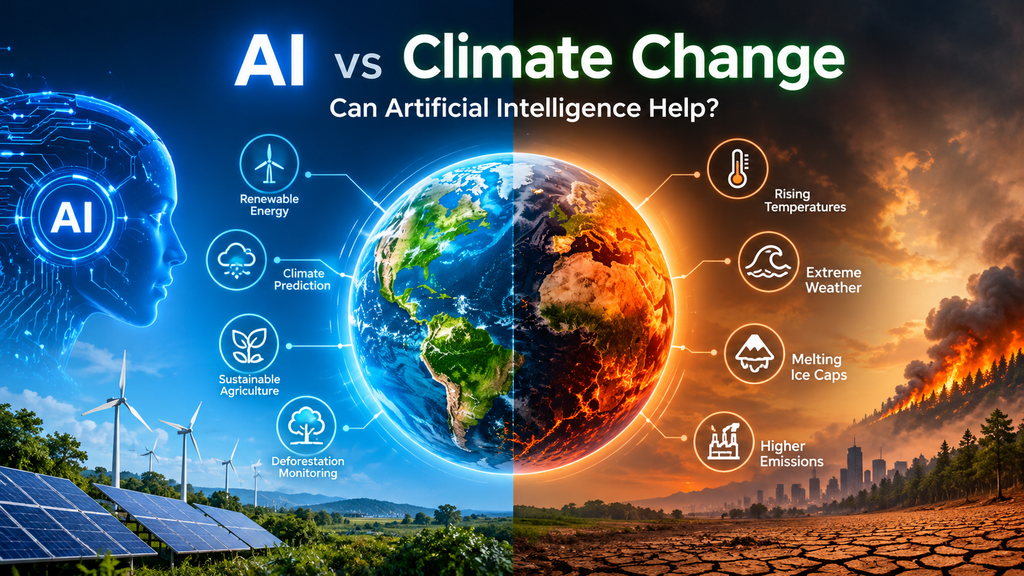
Climate change is one of the biggest challenges facing the world, and artificial intelligence (AI) is becoming one of the most powerful technologies of the modern era. The growing connection between AI and climate change raises an important question: Can AI help fight climate change, or could artificial intelligence make the climate crisis worse?
The answer is more complicated than simply saying AI is good or bad for the environment.
Artificial intelligence can analyze enormous amounts of climate data, predict extreme weather, improve renewable energy systems, reduce industrial waste, and help scientists understand changes in the Earth’s climate. At the same time, training and operating large AI models requires significant computing power, electricity, cooling, and data-center infrastructure.
This creates a fascinating technology-versus-environment challenge.
How Are AI and Climate Change Connected?
The relationship between AI and climate change works in two directions.
First, AI can become a powerful tool for reducing greenhouse gas emissions and improving the way energy and natural resources are used.
Second, AI itself has an environmental footprint. Large AI models require data centers containing thousands of processors. These systems consume electricity and generate heat, requiring cooling infrastructure.
Therefore, the real question is not whether AI is environmentally friendly by itself. The bigger question is:
Can we use AI to reduce more emissions than the technology creates?
AI’s Environmental Footprint
AI systems depend on large-scale computing infrastructure. Training advanced models can require substantial computational resources, while popular AI services may perform millions of queries every day.
The environmental impact depends on several factors, including:
- The amount of computing required
- The efficiency of AI hardware
- The electricity source powering data centers
- Cooling requirements
- Data-center efficiency
- How frequently AI models are trained and used
If a data center operates primarily using fossil-fuel-generated electricity, its carbon footprint can be considerably higher than one powered by renewable energy.
How Can AI Help Fight Climate Change?
Despite its environmental costs, AI for climate change has enormous potential.
AI’s greatest advantage is its ability to process huge quantities of information quickly. Climate systems are extremely complex, involving the atmosphere, oceans, land, ecosystems, weather patterns, and human activity.
AI can help scientists and businesses find patterns that would be difficult to identify using traditional methods.
1. AI Can Improve Climate Prediction
One of the most promising applications of artificial intelligence and climate change technology is climate and weather prediction.
Traditional climate models are extremely powerful but computationally expensive. Machine-learning systems can complement these models by analyzing historical weather data, satellite imagery, ocean measurements, and atmospheric information.
AI can potentially help improve predictions for:
- Heatwaves
- Floods
- Hurricanes and storms
- Wildfires
- Droughts
- Extreme rainfall
- Changing weather patterns
Better prediction can help governments and communities prepare for extreme events before they happen.
Early Warning Systems
An AI-powered early warning system could analyze weather and environmental information continuously.
For example, an AI model could detect patterns associated with an approaching extreme weather event and provide earlier warnings to authorities.
This could give communities more time to evacuate, protect infrastructure, secure food supplies, or prepare emergency services.
2. AI Can Make Renewable Energy More Efficient
Solar and wind power are essential components of the transition toward cleaner energy. However, renewable energy production is variable.
Solar panels produce electricity during daylight and are affected by weather. Wind turbines generate electricity depending on wind conditions.
AI can help solve some of these challenges.
AI and Renewable Energy Forecasting
Machine-learning models can analyze weather forecasts, historical energy production, and real-time sensor data to predict how much electricity renewable sources are likely to generate.
This can help electricity operators balance supply and demand.
AI can also help identify the best locations for renewable-energy infrastructure and detect equipment problems before they become expensive failures.
3. AI Can Reduce Energy Consumption
One of the most important AI climate solutions is improving energy efficiency.
Buildings, factories, transportation systems, and data centers consume enormous amounts of energy.
AI can monitor energy usage and identify opportunities for reducing waste.
For example, an intelligent building-management system could automatically adjust:
- Heating
- Air conditioning
- Lighting
- Ventilation
- Energy storage
- Electricity consumption
Instead of operating equipment according to fixed schedules, AI systems can respond to real-time conditions.
Smart Buildings and Smart Cities
AI can also support the development of smarter cities.
Traffic-management systems can analyze vehicle movement and optimize traffic signals. This can reduce unnecessary idling and potentially lower fuel consumption.
Smart grids can use AI to balance electricity demand, renewable generation, batteries, and other energy resources.
These applications demonstrate how AI climate technology can go beyond simply analyzing climate data.
4. AI Can Help Detect Deforestation
Forests play a critical role in the global carbon cycle.
Satellite images provide enormous amounts of information about forests, but manually analyzing these images is difficult.
AI-powered image-recognition systems can analyze satellite imagery and identify changes in forest coverage.
This can help organizations detect:
- Illegal deforestation
- Forest degradation
- Wildfires
- Changes in vegetation
- Land-use changes
Faster detection can make environmental monitoring more effective.
5. AI Can Improve Agriculture
Agriculture is another area where AI and global warming are increasingly connected.
Climate change can affect rainfall, crop yields, soil conditions, pests, and water availability.
AI-powered agricultural systems can analyze weather forecasts, soil information, satellite images, and crop data to help farmers make better decisions.
AI can potentially help farmers determine:
- When to plant crops
- When to irrigate
- How much water to use
- Where crops are under stress
- When diseases may appear
- Which areas require additional resources
Using resources more efficiently can reduce waste while potentially improving agricultural productivity.
The Biggest Problem: AI Energy Consumption
While AI can provide important climate change solutions, its growing energy demand cannot be ignored.
Large AI models require powerful processors and data centers. These facilities consume electricity and need cooling systems to operate safely.
As AI adoption increases, the demand for data-center capacity is also expected to grow.
This creates an important contradiction:
AI could help reduce emissions in many industries while simultaneously increasing energy demand through its own infrastructure.
AI Carbon Emissions
The carbon footprint of AI depends heavily on where and how computing takes place.
An AI system powered by electricity generated from renewable sources can have a significantly different environmental impact from one operating in a region heavily dependent on fossil fuels.
This means that the future of AI is closely connected to the future of electricity generation.
Can AI Become More Sustainable?
Yes, but several improvements are necessary.
More Efficient AI Models
Not every task requires the largest possible AI model.
Smaller, specialized models can sometimes perform specific tasks using considerably fewer computational resources.
Developers can also optimize models so they require less memory and processing power.
More Efficient AI Hardware
Modern AI chips are becoming increasingly specialized for machine-learning workloads.
Better hardware efficiency means more computation can potentially be performed using less electricity.
Renewable-Powered Data Centers
Another important solution is powering data centers with renewable energy.
Solar, wind, hydroelectric, nuclear, and other low-carbon electricity sources can reduce the emissions associated with AI infrastructure.
The Future of AI and Climate Change
The future relationship between AI and climate change will depend on how responsibly the technology is developed and deployed.
AI should not be viewed as a magical solution to global warming. It cannot replace renewable-energy investment, government policies, emissions reductions, conservation, or changes in industrial practices.
Instead, AI should be viewed as a tool.
A powerful tool can be used effectively or inefficiently.
If AI helps electricity grids become smarter, factories become more efficient, agriculture use less water, renewable energy become more predictable, and climate risks become easier to forecast, its benefits could be substantial.
However, if AI development continues to increase energy consumption without sufficient attention to efficiency and clean electricity, its environmental footprint could become a growing concern.
AI vs Climate Change: Which One Will Win?
The answer does not have to be one or the other.
AI can become part of the climate solution—but only if the technology itself becomes more energy efficient and is powered increasingly by cleaner sources of electricity.
The most important opportunity is to use AI where it can create meaningful environmental benefits that outweigh the resources required to operate it.
From predicting extreme weather to optimizing renewable energy, monitoring forests, improving agriculture, and reducing industrial waste, the potential applications are enormous.
A Technology With Two Sides
AI is neither automatically a climate savior nor automatically a climate threat.
It is a technology with both benefits and costs.
The challenge for governments, technology companies, researchers, and businesses is to maximize AI’s ability to solve environmental problems while minimizing its own carbon footprint.
What Consumers Can Do
Individuals can also contribute by using technology responsibly, supporting clean-energy initiatives, reducing unnecessary energy consumption, and choosing services and companies that take sustainability seriously.
The Bigger Picture
Climate change is a problem that requires many different solutions.
AI will not solve climate change on its own. But when combined with renewable energy, energy efficiency, scientific research, sustainable transportation, conservation, and effective climate policies, artificial intelligence could become one of the most valuable technologies in the fight against global warming.
Final Thoughts
The debate should therefore not simply be “AI vs climate change.”
A better question is:
“How can we make AI part of the climate solution without creating another environmental problem?”
The answer will depend on innovation, responsible development, cleaner energy, and smarter use of computing resources.
If those priorities remain at the center of AI development, artificial intelligence could play a major role in building a more efficient and sustainable future.