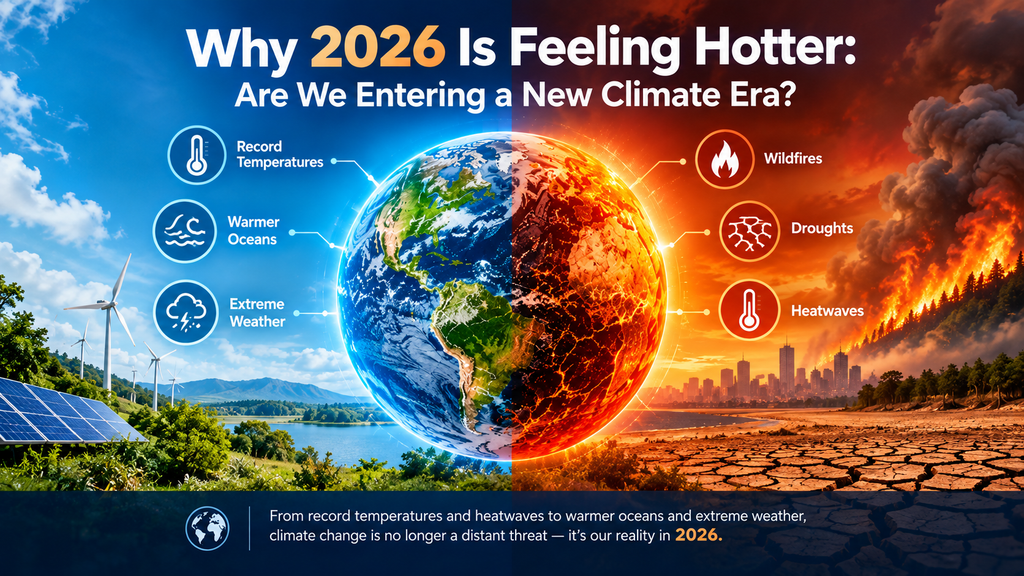
Have you noticed that summers seem harder to tolerate, heatwaves feel more intense, and extreme weather events are appearing more frequently in different parts of the world?
You are not alone.
The question of why 2026 is feeling hotter has become increasingly important as global temperatures continue to remain exceptionally high. Climate change is no longer something that exists only in scientific projections. It is increasingly visible through heatwaves, warmer oceans, changing rainfall patterns, wildfires, droughts and other extreme weather events.
According to the World Meteorological Organization (WMO), 2015–2025 were the 11 hottest years on record, while 2025 was among the three warmest years ever recorded. WMO’s 2026–2030 outlook also indicates that global temperatures are likely to remain near record levels.
So, are we entering a new climate era?
The answer requires some nuance.
Why Is 2026 Feeling So Hot?
The biggest reason is straightforward: Earth’s climate system has accumulated enormous amounts of heat because of greenhouse gas emissions.
Carbon dioxide, methane and other greenhouse gases trap heat in the atmosphere. Human activities such as burning coal, oil and gas, industrial production, transportation and deforestation have increased the concentration of these gases.
The result isn’t simply that every day becomes hotter.
Instead, the entire climate system is becoming warmer, increasing the likelihood and intensity of many types of extreme weather.
Global Temperatures Are Remaining Exceptionally High
WMO’s latest climate update predicts that annual global mean temperatures from 2026 to 2030 are likely to remain between approximately 1.3°C and 1.9°C above the 1850–1900 average.
It also estimates an 86% chance that at least one year between 2026 and 2030 will exceed 2024 as the warmest year on record.
These figures don’t mean that every location will experience exactly the same amount of warming.
Land generally warms faster than oceans, and some regions experience much larger temperature changes than the global average.
Heatwaves Are Becoming a Bigger Climate Risk
Why Heatwaves Feel Different Today
A heatwave is not simply a hot day. It is a period of unusually high temperatures relative to what is normal for a particular location and season.
Climate change increases the baseline temperature from which heatwaves occur.
Imagine a city historically experiencing a maximum summer temperature of 35°C. If the underlying climate becomes warmer, temperatures that were previously considered unusual can become more common.
This matters because heat affects:
- Human health
- Electricity demand
- Agriculture
- Water availability
- Outdoor work
- Transportation
- Infrastructure
- Urban living
Cities can experience an additional problem known as the urban heat island effect, where roads, buildings and concrete absorb and retain heat.
H4: Why Night-Time Heat Matters
One particularly important concern is nighttime temperature.
If temperatures remain high after sunset, the human body has less opportunity to cool down and recover from daytime heat.
This can increase heat stress, especially among vulnerable populations.
H2: The Ocean Is Also Getting Warmer
It is easy to think of climate change as an atmospheric problem, but the ocean is central to the climate system.
The ocean absorbs enormous quantities of excess heat generated by greenhouse gas warming.
WMO reports that the ocean has been absorbing about 18 times the annual energy use of humanity each year over the past two decades.
H3: Why Warm Oceans Matter
Warmer oceans can influence:
- Tropical storms
- Rainfall patterns
- Marine ecosystems
- Coral reefs
- Sea levels
- Ocean circulation
- Coastal communities
Ocean warming also contributes to marine heatwaves, periods when ocean temperatures remain unusually high for an extended period.
H2: Are Extreme Weather Events Becoming More Dangerous?
Climate change does not mean that every individual storm, flood or drought is caused solely by global warming.
Weather naturally varies.
However, climate change can alter the conditions in which extreme events occur.
For example, a warmer atmosphere can hold more moisture, potentially contributing to heavier rainfall in some circumstances. At the same time, higher temperatures can increase evaporation and worsen drought conditions in other regions.
This creates a complicated picture where different parts of the world can experience different climate risks simultaneously.
H3: Wildfires and Drought
Hotter temperatures can dry vegetation and soils, increasing fire risk when other conditions are favorable.
Longer or more intense dry periods can also put pressure on agriculture and water resources.
This creates a potential chain reaction:
Higher temperatures → greater evaporation → drier landscapes → increased fire and water stress.
H2: What Do Scientists Expect Next?
The short-term outlook is concerning but should not be interpreted as a prediction that every year will establish a new temperature record.
Natural climate variability still matters.
Phenomena such as El Niño and La Niña can temporarily influence global temperatures.
However, these natural cycles occur on top of a long-term warming trend caused primarily by human greenhouse gas emissions.
WMO’s latest projections indicate that temperatures are likely to remain at or near record levels during the coming years.
H2: Does This Mean Climate Change Is Becoming Irreversible?
Some climate changes can continue for decades or centuries even if emissions are reduced.
Sea-level rise is one example.
The IPCC states that sea levels will continue rising beyond 2100, although the amount and rate of future rise depend strongly on future emissions.
This does not mean that nothing can be done.
Every fraction of a degree matters.
Reducing greenhouse gas emissions can lower future warming and reduce many climate-related risks.
H3: What Can We Still Do?
The most important solutions include:
- Expanding renewable energy
- Improving energy efficiency
- Electrifying transportation
- Protecting forests
- Reducing methane emissions
- Improving public transportation
- Developing climate-resilient cities
- Reducing food waste
- Supporting sustainable agriculture
H2: Are We Entering a New Climate Era?
In many ways, we are already experiencing a different climate environment from the one that existed before large-scale industrialization.
But calling 2026 the beginning of a completely new climate era would be an oversimplification.
The more accurate conclusion is that human-caused warming is pushing the climate system into increasingly unfamiliar territory.
The future isn’t predetermined.
The amount of warming experienced in the coming decades will depend heavily on choices made today.
H2: Final Thoughts
The reason 2026 feels hotter isn’t simply a bad summer.
The bigger story is the accumulation of heat throughout Earth’s climate system.
With global temperatures remaining exceptionally high, ocean heat reaching records and extreme weather affecting communities worldwide, understanding climate change has never been more important.
The good news is that climate action still matters.
Every fraction of a degree of warming avoided can mean fewer risks to people, ecosystems, food systems and future generations.